“It is good to be in pairs . . .”1
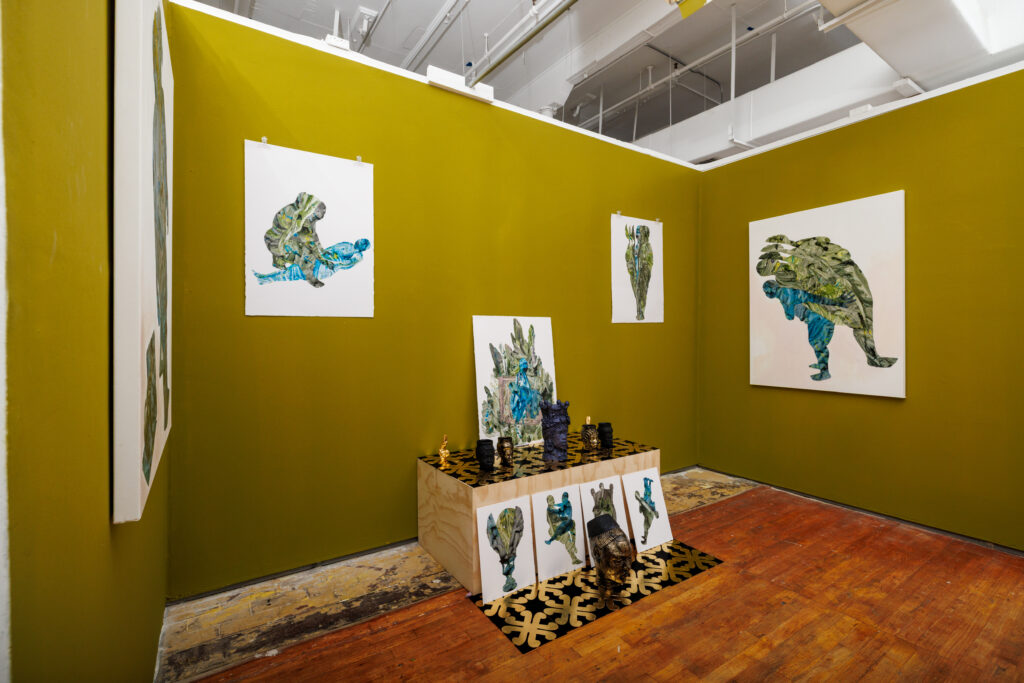
M. Florine Démosthène’s installation Two Heads Are Better Than One mirrors the form of altars or shrines from Africa or Ayiti but simultaneously possesses a decryption key for historical allegories that employ the body in diverse ways to shoulder both the burden and hope of ancestral memory.2 In Démosthène’s words, “By mining the past to propose an alternate future, it alludes to the capacity for traditions to persist and be reenvisioned through the diaspora.”3
Venɔnɔ nyo, the Ewe symbol for mutuality, depicts two figures face-to-face but joined at the roots.4 On Démosthène’s shrine, this symbol is reproduced in black and gold and doubly mirrored and then repeated in a pattern reminiscent of tiled floors in Northern Africa. This shimmering overlay and concept speaks of interconnectedness, comradeship, and the sociocultural value of shared roots. Démosthène’s pattern both foregrounds the altar table and forms its surface, and it is a fundamental aspect of both the installation and her generous work overall.
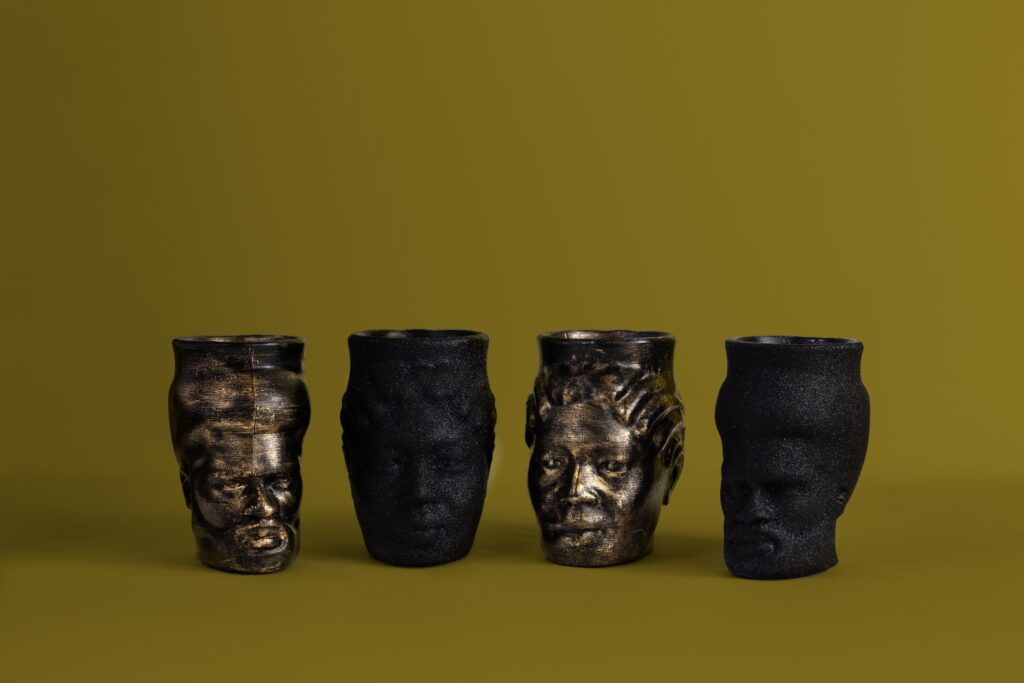
The altar itself holds five heads, while another more elaborate bust sits in front. Some of these components are fashioned after statues looted from African shrines and now spiritually “altered/altared” for display at the Metropolitan Museum of Art and British Museum . . . having been sent on transatlantic journeys from the sacred to the profane to the vitrine. There are some heads based on 19th–20th-century West African Ibeji twin figures5 and others based on 5th-century BCE Greek terracotta water-carrying vases in the form of a Black African’s head.6 This introduces an uneasy but vital juxtaposition between the depiction of the Black head for spiritual purposes and that for utilitarian ones. As Démosthène notes, “Some of the pieces are refashioned, remodeled Greco-Roman vases that feature Africans . . . [while others] are ritualistic objects.”7
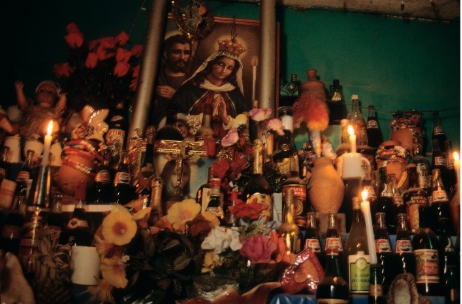
In the Haitian religion Vodou, a spirit is honored by altars bearing objects, both sacred and profane, that are peculiar or necessary to it. These altars are housed in the small rooms called badji that are often located in the perimeter of the hounfor (temple). The offerings range from chromolithographs of synchronistic Catholic saints to bottles of rum, perfume, and cola to seemingly random objects, such as toy boats, shovels, and dolls. Gifts of food are also left as both enticements and rewards.
Objects shift in meaning and power on a Vodou altar: Some have magical agency, some are illustrative, some are symbolic, and some are meant for consumption. Posters based on the renowned Richard Avedon photograph of Nastassja Kinski with a python coiled around her body found their way onto numerous Vodou altars in the 1980s to represent Damballah (the snake spirit).8 In the 1990s, in a temple in Bel Air, Port-au-Prince, Bart Simpson was found to have sufficient mystical agency to command a central position on an altar dedicated to the Marasa (divine twins). Edgard Jean-Louis, the presiding houngan (priest), explained, “This is due to Bart Simpson’s mischievous attitude but also the duality of his nature crossing from vakabon pou zanj [naughty to angelic] so easily.”9 Bart, the ultimate cartoon trickster, could also be said to be in a dualistic relationship with his sensible and grounded sister Lisa, which furthers his suitability for the Marasa.
It is this slippage of signs and signifiers—perhaps a response to the many religious pogroms against Vodou creating the need to secrete the visual aspects of worship—that Démosthène utilizes so effectively in Two Heads Are Better Than One to convey “the idea of the shrine showing spiritualized individual objects, spiritual objects that sit in museums, and objects relating how Blacks were depicted in antiquity.”10
There are also two identical shiny golden outliers on Démosthène’s shrine—one facing the back, and the other, the front. These smaller figurines are based on an ancient Roman statue of an African acrobat balancing on the back of a crocodile.11 They depict the legendary Tentyritae, courageous Nilotic crocodile hunters famed for catching the ferocious reptiles with their bare hands and then riding them.12 In her small statues, Démosthène has depicted the elegant gymnasts, absent the crocodiles and thus detached from their dangerous aqueous task but nonetheless in an invisible bond of attachment and dependence. It is from this uncanny dance of complicated kinship that the viewer can segue to Démosthène’s ink, paper, and glitter paintings, which surround the altar and evoke much of her earlier work.
Everything that glitters ain’t fish scale. —MF DOOM, “Figaro”13
The figures in Florine Démosthène’s collages drift and waft and inhabit spaces that transgress earthly pull. The palette often consists of watery blues or ophidian greens. And even the rarer coral shades seep and flow from one space to another . . . always fluid . . . and nearly always marking a body. A sole figure is rare, as for Démosthène, relationship is essential. There is sometimes a shadow countenance . . . obsidian black or deep blue and mottled . . . as if a glimpse into another galaxy or universe.
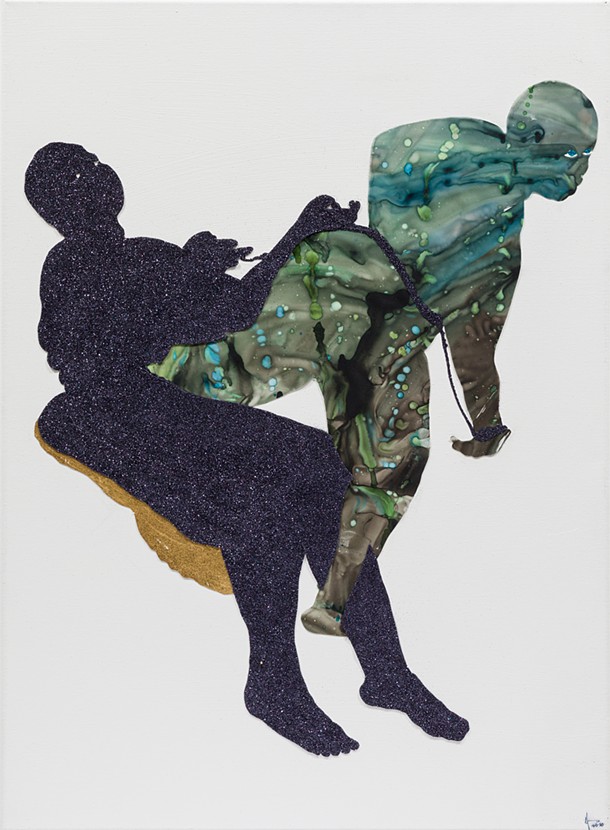
There is a gestural complexity to the relationship between these two bodies that is at times nurturing, but often at unknowable cost. These are not comfortable relations. Indeed, they mirror and dangle; they struggle one against the other; they piggyback, burden, and cling. Some of these encounters evidence the confluence of different kingdoms and opposing currents . . . of rescue and salvation among the abject and drowning in underwater realms marked by and delineated with rockweed and tangle . . . a discernible habitat for Démosthène’s inchoate figures. If the sea is an alien environment, then her figures are navigating remote territories. If depictions of ancestors, they counter any rigid orthodoxy of the visual codes and queer their spiritual countenance.
A mind which sought to interpret the world by using a single loa. Somewhat like filling a milk bottle with an ocean. —Ishmael Reed, Mumbo Jumbo14
There exist two underwater kingdoms of the imaginary that serve as Atlantic Passage mythopoeia: Ginen and Drexciya . . . the first as a crucible of the gods and ancestral homeland, and the second as a sonic-techno-Afro-sci-fi call to arms. Unlike Plato’s Atlantis, a legendary civilization that sank beneath the sea when its inhabitants fell from favor with the gods, these holy lands are born at the site of trauma as repositories of familial loss, paradisiacal hope, and divine redemption.
“Drexciya” [external link15] is the name of an African American dancefloor electro band formed in Detroit in the early 1990s. In the liner notes to their 1997 album The Quest, the group introduces their oceanic Afro-futurist fantasy of an underwater land, also called Drexciya, that is populated by the offspring of pregnant African women either thrown or self-propelled from slave ships in transit. Their unborn children, protected by the fluid of their mothers’ amniotic sacs, survived and emerged in the aquatic depths. These transmogrified kith and kin peopled an underwater nation that formed an amphibian brigade of revolutionaries preparing to wrestle retribution for the transatlantic slave trade.16
This jives with Paul Gilroy’s reimagining of a Black Atlantic as a “counterculture of modernity,”17 placing Démosthène’s reptilian-hued peoples within a transcontinental ecosystem created by the involuntary odyssey of enslaved peoples. The strength of her work is that it also attests to the consequent internecine rivalries . . . her often struggling bodies showing that these new allegiances were marked by anxiety and disquiet, and that their futures were often haunted by the specters of past ordeals.
Experience of the abyss lies inside and outside the abyss . . . straight from the belly of the slave ship into the violet belly of the ocean depths they went. —Édouard Glissant, Poetics of Relation18
Ginen is an alternative Black Atlantic realm within Haitian Vodou mythopoesis, a paradisiacal aqueous landscape peopled by the spirits and the ancestors. Again, the concept of Ginen is said to derive from the lived experience of going overboard from a slave ship into the depths of the Atlantic—from a necessary belief that there was some salvation if you threw yourself or were thrown (often as cynical insurance deals on the part of the enslavers) from a boat transporting enslaved Africans.
Glimpses of a utopian Ginen, as a home for the spirits, can be found in the remarkable works of Haitian painters such as Edouard Duval-Carrié (b. 1954), Andre Pierre (ca. 1916–2005), and Frantz Zéphirin (b. 1968). This aquatic kingdom serves multiple purposes . . . as the abysmal waters of Vodou death rituals where the gwo bon anj (the soul)19 must descend for a year and a day; as a liquescent Valhalla for the ancestral spirits; as a reciprocal stand-in for the lost homeland of Africa; and as the court of the aquatic Vodou spirits Agwe, Lasiren, and Labalenn. Agwe is an admiral and reflects the maritime past of Haiti, but it is his consorts, Lasiren and Labalenn, who appear more often in Démosthène’s collages. Lasiren, a mermaid who possesses the wisdom of the water’s depths and is said to make eerie music on the ocean floor, is held to be the patron of musicians. She is an ephemeral presence that can lure a person to return to the ancestral home of Ginen, to Africa, and the dwelling place of the lwa anba dlo (spirits beneath the water).
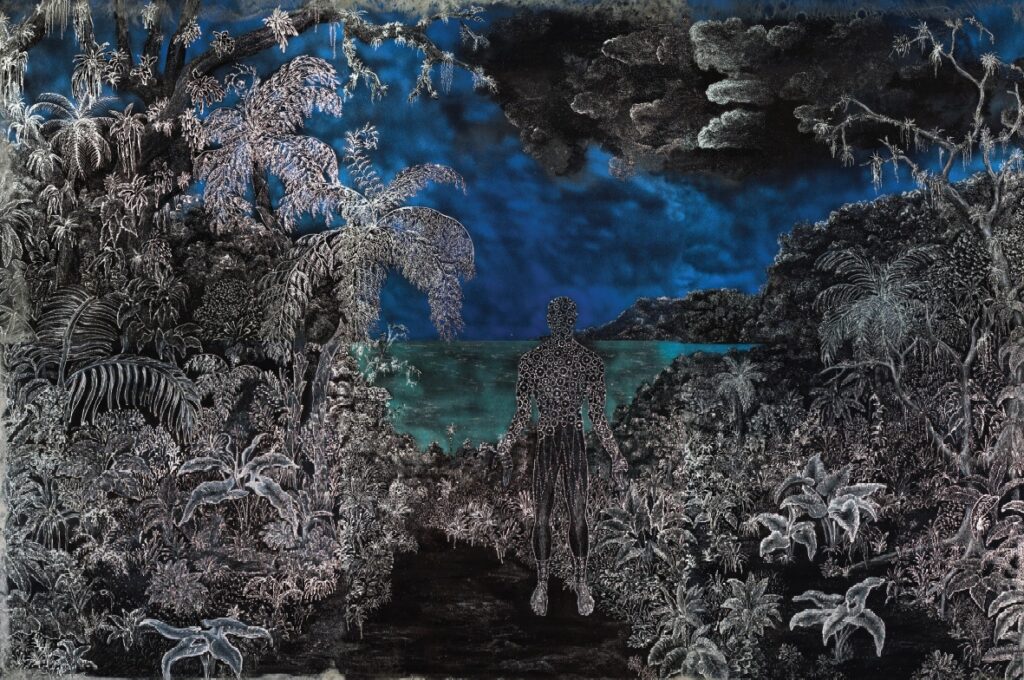
Lasiren is characterized by dual aspects, like fish skin that can reflect two colors. As Lasiren, she is bewitching and pearly and has long, often blonde hair, but her shadow countenance is Labalenn, the whale, who is black, shiny, and fearful and represents the dark shadow that can be glimpsed deep beneath the waves. It is this awkward duality, which reenacts dilemmas of gender and race in postcolonial Haiti, that can be sensed in the complex dance of gesture and tension in Démosthène’s figures. The reflective, iridescent mermaids engendering male fantasies of enchantment over the centuries and the dark, absorbent Labalenn, the scourge of Captain Ahab20 (and, along with enslaved Africans, another profitable 17th-century commodity), are equally caught in a maladroit choreography characterizing the fiscal issues of skin hue in the Haitian nation and global economies.
Two distinct classes emerged from the Haitian revolution and held extremely contradictory visions of an economic, social, and political future: The first was a small minority, predominantly mulattoes privileged to own property before the revolution and expecting to inherit the power and fortunes formally controlled by the French colonialists. The second and majority class consisted principally of formerly enslaved Black Africans who had battled against the plantation system and resisted attempts to be co-opted back into economic servitude. Turning their backs on the West-facing state, they started working the land for subsistence. This largely peasant class maintained its “counter-plantation” position through a triumvirate of linguistic, territorial, and cultural resistance—the Kreyòl language, the belief system and ritual practices of Vodou, and the subaltern land-management system known as the Lakou.
The language of Kreyòl, born on the colonial plantations, emerged as a basic and rough method of communication among the culturally and geographically diverse populations of the colony. After the slaves’ revolt, Kreyòl became a language of resistance and retreat from the metropolitan state, which continued to use French as the lingua franca of power and capital in Haiti. Vodou, a creolized religion forged by African slaves and their descendants, is comprised of elements from a wide range of diverse religious practices, including those of the Fon, Dahomey, Kongo, Yoruba, and other African people; Christianity; and the spiritual traditions of the Indigenous Taino Indians, who were the original inhabitants of the region. The Lakou—a system of communal living in the rural provinces of Haiti in which extended and multigenerational families inhabited houses clustered around a shared yard in order to engage in collective land management and ownership, cooperative labor, and trade practices—served as a means of resisting the return to the plantations.
As they suffered together through the trauma of plantation life, Africans and creoles developed their own rituals of healing, mourning, and worship. —Laurent Dubois, Haiti: The Aftershocks of History21
This struggle between the lighter-skinned minority and the Black majority undercuts many major Haitian historical moments. Often characterized by the uses and abuses of skin color, or politique de doublure (proxy politics), it frequently led to Black presidents being installed and manipulated for the economic success of the wealthy mulatto and Black elites. During this period, the mass of rural peasants remained largely politically inactive, sporadically called upon to help topple a particular government and then immediately dropped and ignored. These unequal relationships are recalled in the ambiguous gestures of Démosthène’s figurations: There are the lineaments of trust, but these shift and metamorphose to the embodiments of doubt and wariness . . . situations in which care becomes control, and release becomes jettison.
The device of twinning and doubling to create a sense of the uncanny has been used by many African studio portrait photographers including “Seydou Keïta” [external link22] (1921–2001) and Malick Sadibé (1936–2016) and even on occasion arch-self-portraitist Samuel Fosso (b. 1962). The double take at a double embodies a radical ambiguity of realism: The representation of twins is a queering of encounters. One twin is often supernatural while the other is prosaic, as are twin half-brothers Castor and Pollux in Greek mythology. The double handshake is performed in Haitian Vodou ceremonies to emblematize the profane world and its mirrored spiritual inversion. These skeptical relationships are also mirrored in the Marasa, the Vodou spirits of the divine twins.
The Marasa are grands mysteres, ancient spirits that crossed the oceans to Haiti from Africa and, as such, are saluted after Legba in a Haitian Vodou ceremony. They are representative of the first dead and considered deeply magical ancestral spirits. But as a symbolic visual code for equality, twins are ironically enmeshed in multiple systems of hierarchy. The next child born to a mother after she has birthed twins is a Dosu or Marasa Twa and thought to possess even more mystical power than the twins. But the offspring born to a mother before the birth of her twins is called the Dosu Avant or Chuket and has extremely low standing in the eyes of the divine. As with much of Démosthène’s work, there are these inner contradictions, struggles, and conflicts surrounding twins. They uphold and symbolize reciprocity and mutuality while simultaneously reversing and transgressing this state of symbiosis.
Both as archetype and image, the matter of Twins appears at first clear and accessible, yet soon becomes elusive and baffling. —John Lash, Twins and the Double23
There is a violence in some of the themes and myths that swirl around twins and the Marasa. A newborn with webbed feet, for example, counts as a twin, as this physical characteristic is a sign that the child has “eaten” their sibling in the womb. There are also many, perhaps apocryphal, Haitian stories about twins wreaking vengeance on their mother for a tiny perceived slight. In dual gender twins, in cases where the girl grows in strength and size while the boy is diminished, it is believed that the sister is “eating” her twin brother due to a mutual antipathy that has existed since birth. As the proverb Marasa yo raisab (Twins don’t get on) expresses, it is considered commonplace in Haiti for twins to fight each other. But there are also tales of unbreakable bonds that continue after the death of one twin, whereby the surviving twin sets aside a portion of each meal for their deceased double.24
The idea of Marasa illuminates Haiti’s social and racial problematic, intimating a path toward healing through the acceptance of its twin-ness, and thus the notion that its hybridity could lead to a creole culture. —Florence Bellande-Robertson, “A Reading of the Marasa Concept in Lilas Desquiron’s Les Chemins de Loco-Miroir”25
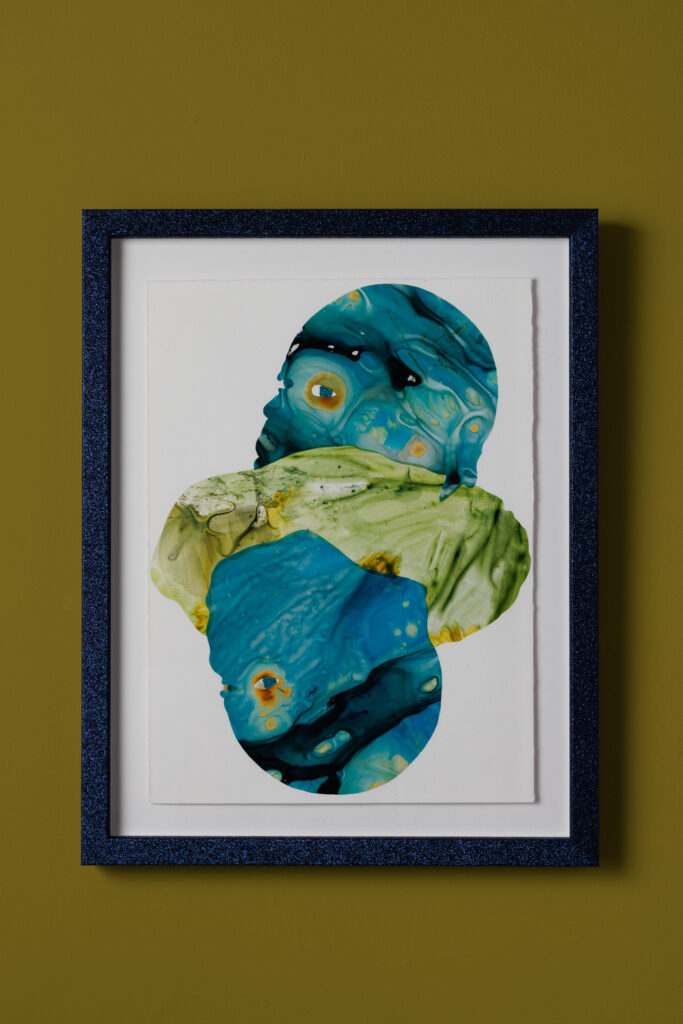
The roots of the word “twin” denote both coupling and disengagement, uniting and departing, and these expressions find dynamic visual symbolic motion in Démosthène’s works, a visual form of W. E. B. Du Bois’s “double-consciousness,” which characterizes Black experience as a doubling of identity and being, the coupling of public and private personae within Black cultural production and the struggle that ensues.26
It is a peculiar sensation, this double-consciousness, this sense of always looking at one’s self through the eyes of others. . . . One ever feels his two-ness, —an American, a Negro; two souls, two thoughts, two unreconciled strivings; two warring ideals in one dark body, whose dogged strength alone keeps it from being torn asunder. —W. E. B Du Bois, The Souls of Black Folk27
Démosthène’s figures are possibly more Ginen than Drexciyan, less hard-edged and dreamier . . . like spongiform figurative expressionism. The palette and form are reminiscent of Saint Soleil, a rural community of Haitian painters who liquified the lexicon of spirit representation. Démosthène’s gestural breadth touches on themes of race, class, gender, sexuality, violence, the gaze, postcolonialism, and identity, expressing the connections and disconnects of allegiance and similarity. Her work surfs on waves of mimetic energy that could indicate or challenge the viewer to realize other ways of being synonymic and of being other. Her work endures as an irriguous haunting of Paul Gilroy’s concept of “the Black Atlantic,” delineating a unique territory that is not specifically African, American, Caribbean, or European but rather a set of bodily coordinates that map the hybridity of Black Atlantic culture.28
A preoccupation with the striking doubleness that results from this unique position—in an expanded West but not completely of it—is a definitive characteristic of the intellectual history of the Black Atlantic. —Paul Gilroy, The Black Atlantic29
There is a resurgence in the production of the figure by Black artists that, on one level, reflects the stark absence of the Black figure during centuries of portraiture and, on the other, utilizes the figure as a tool for exploring multifarious definitions of Blackness. This radical attentiveness to the Black body enables an exploration of interpretations of the past, representations of the present, and the chance to reimagine the future. The figure posits a reassessment of occluded, disavowed, forgotten, or suppressed histories and can respond to the demand for the decolonization of public spaces challenging the abject lack of diversity.
Démosthène’s work is in flux and dialogue with many Black artists, and aspects of her work echo the silhouettes of Kara Walker (b. 1969), body prints of David Hammons (b. 1943), allusions to Vodou flags by Kerry James Marshall (b. 1955), and marine imaginaries by Wangechi Mutu (b. 1972) and Ellen Gallagher (b. 1965). The work is hopeful and, at the same time, marks the complexity of the historic struggles of Haitian, Caribbean, and African American people.
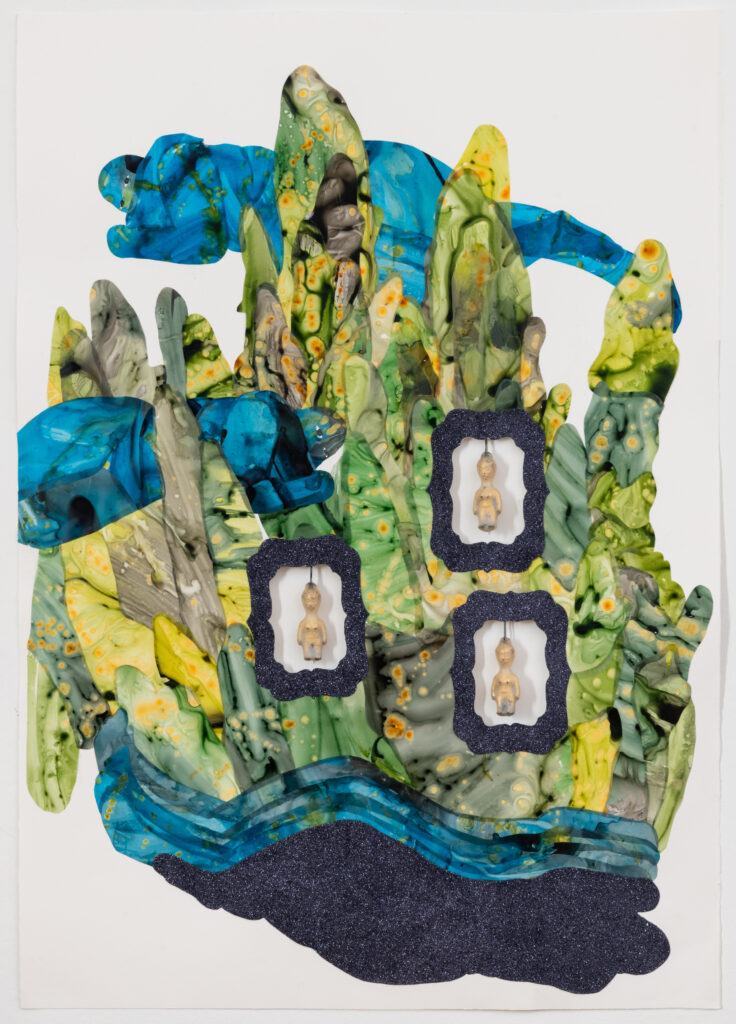
Démosthène’s corporeal abstractions radically address the skin and its ability to transmit and absorb. The skins of her figures are either formed of opalescent colors bleeding into one another or are a dark, somber, and muted but bespeckled universe, unreflective and matte. The great strength of her work is the way in which these figures interact . . . the way in which the ancestors hover and float in an odd dance and marriage of kith and kinship as witnesses to history and struggle. In Black Skin, White Masks, Frantz Fanon argues that his Black skin condemns him to be captive to his corporeality, not only the object of but also the incarnation, of a white gaze.30
If there is an inferiority complex, it is the outcome of a double process:
—primarily, economic;
—subsequently, the internalization—or, better, the epidermalization—of this inferiority.
—Frantz Fanon, Black Skin, White Masks31
Démosthène’s work implies a complexity in the dermis: The skin feels fungible. It sheds, molts, and disburdens its symbolic codes, displaying inner and outer spaces and lives. The Haitian diaspora continues to journey, and on every voyage, their culture and tradition accompany them, as on the first forced passage out of Africa. This culture transmutes and transmits a signal of the same composition but at a different frequency at each new location, and it depends on the inherited mutuality of Venɔnɔ nyo (Living together is good).
If capitalism can be seen to a certain extent as the formalization of the hierarchies created by surplus creating activities, then Démosthène’s works simultaneously show these hierarchies to be in a state of flux and map the shifting dynamics . . . Her works are the barnacles on the back of the whale of history. If history has disavowed Haiti’s modernity, then Démosthène’s works articulate the struggle to wrestle it back . . . They are a hauntology of Haitian cosmologies, ideologies, and histories . . . not just a poetics of loss but a poetics of relation, too.
Tout Marasa pa menm. (All twins are not the same.) —Haitian Proverb
- Gemini, response to “What is the Ewe adinkra symbol for mutuality?” Google, August 13, 2026.
- Démosthène created Two Heads Are Better Than One during the 2025 Caribbean Cultural Institute Artist Fellowship through Peréz Art Museum Miami (PAMM) at Bakehouse Art Complex.
- “M. Florine Démosthène,” Caribbean Cultural Institute at PAMM website, https://cci.pamm.org/fellows/m-florine-demosthene/.
- The Ewe are a West African people whose traditional homeland spans southeastern Ghana, southern Togo, and southwestern Benin. They speak Ewe, one of the Gbe languages, and their spiritual traditions are among those that gave rise to Vodun.
- Ibeji Town Figure, Yoruba artist, 19th–20th century, Nigeria, wood, beads, camwood powder, pigment, 9 1/4 × 3 9/16 in. (23. 5 × 9 cm), Metropolitan Museum of Art, New York, object no. 1979.527.22, https://www.metmuseum.org/art/collection/search/314081.
- Terracotta oinochoe (jug) in the form of a Black African’s head, Greek, Attic, c. 480 BCE, terracotta; red-figure, H. 6 1/16 in. (15.4 cm), Metropolitan Museum of Art, New York, object no. 00.11.1, https://www.metmuseum.org/art/collection/search/246891.
- Florine Démosthène, WhatsApp communication with author, July 1, 2026.
- Richard Avedon, Nastassja Kinski and the Serpent, Los Angeles, California, 1981, gelatin silver print, 28 3/4 × 42 3/4 in. (73 × 108.6 cm), Museum of Fine Arts, Houston, object no. 2002.2976, https://emuseum.mfah.org/objects/63829/nastassja-kinski-and-the-serpent-los-angeles-california.
- Edgard Jean-Louis, interview with author, 1997. This conversation took place as part of research undertaken for The Pig’s Tale, a documentary directed by the author and Anne Parisio and aired on Channel 4 in October 1997, https://vimeo.com/56612439.
- Démosthène, WhatsApp communication with author.
- Statue, Roman, 1st century BC–1st century (probably), marble, 29 1/2 × 14 15/16 in. (75 × 38 cm), British Museum, London, object no. 1805,0703.6, https://www.britishmuseum.org/collection/object/G_1805-0703-6.
- Pliny the Elder, The Natural History, trans. John Bostock (Taylor and Francis, 1855), 8.38, http://data.perseus.org/citations/urn:cts:latinLit:phi0978.phi001.perseus-eng1:8.38.
- “Figaro,” by MF DOOM and Madlib, track 12 on Madvillain, Madvillainy (Stone Throw Records, 2004).
- Ishmael Reed, Mumbo Jumbo (Doubleday, 1972), p. 24.
- “Drexciya: Harnessed The Storm,” Tresor Berlin, https://tresorberlin.com/product/drexciya-i-harnessed-the-storm-i-tresor-181x-2lp-i-white-vinyl/
- The Quest by Drexciya (Submerge Recordings, 1997). The liner notes are credited to “The Unknown Writer.” For an image, see “Drexcity—The Quest,” Discogs, https://www.discogs.com/release/1545133-Drexciya-The-Quest/image/SW1hZ2U6MjI0NzY1MA==?srsltid=AfmBOorI7TCocV6wAk1shGVsGGAhbiG-N56r0YBHQxCi0U8vtOSqZ7PB.
- Paul Gilroy, The Black Atlantic: Modernity and Double Consciousness (Verso, 1993), p. 1.
- Edouard Glissant, Poetics of Relation, trans. Betsy Wing (University of Michigan Press, 1997), p. 7.
- Translates from Kreyòl as “big good angel.”
- Captain Ahab is the fictional character searching for the white whale in Herman Melville’s 1851 novel Moby-Dick.
- Laurent Dubois, Haiti: The Aftershocks of History (Picador, 2012), p. 22.
- Seydou Keïta,” Deutsche Börse Photography Foundation, https://www.deutscheboersephotographyfoundation.org/en/collect/artists/seydou-keita.php
- John Lash, Twins and the Double (Thames & Hudson, 1993), p. 5.
- See Alfred Métraux, Voodoo in Haiti, trans. Hugo Charteris (Schoken Books, 1972), pp. 146–53.
- Florence Bellande-Robertson, “A Reading of the Marasa Concept in Lilas Desquiron’s Les Chemins de Loco-Miroir,” in Haitian Vodou: Spirit, Myth, and Reality, ed. Patrick Bellegarde-Smith and Claudine Michel (Indiana University Press, 2006), p. 103.
- See W. E. B. Du Bois, The Souls of Black Folk: Essays and Sketches (1903; Dover Publications, 1994).
- Du Bois, The Souls of Black Folk, p. 2.
- Gilroy, The Black Atlantic, p. 58.
- Gilroy, The Black Atlantic, p. 58.
- See Frantz Fanon, Black Skin, White Masks, trans. Charles Lam Markmann (Grove Press, 1967).
- Fanon, Black Skin, White Masks, p. 11.